RegelWerk – Home

Regeln und Verbindlichkeit
im Studium

Was bewirken sie?

RegelWerk research group

Which rules help students succeed?

RegelWerk explores how admissions, academic advising and examination rules relate to students’ progress and success at university.

Four project partners · 2025–2029

People taking notes with notebooks on their laps in a row of seats.
Photo: Sincerely Media / Unsplash

Degree completion compared

30% graduate within eight semesters in Germany.

Bachelor’s entrants in the 2020 academic year.

0 % 20 % 40 % 60 % 80 % 100 % United Kingdom: 80.4 % · OECD, theoretical programme duration + 1 year UK Türkiye: 78.5 % · OECD, theoretical programme duration + 1 year TR Ireland: 74.3 % · OECD, theoretical programme duration + 1 year IE Canada: 68.6 % · OECD, theoretical programme duration + 1 year CA Norway: 67.5 % · OECD, theoretical programme duration + 1 year NO Switzerland: 65.8 % · OECD, theoretical programme duration + 1 year CH Portugal: 64.6 % · OECD, theoretical programme duration + 1 year PT Romania: 64.5 % · OECD, theoretical programme duration + 1 year RO Lithuania: 63.5 % · OECD, theoretical programme duration + 1 year LT Iceland: 61.8 % · OECD, theoretical programme duration + 1 year IS Finland: 61.4 % · OECD, theoretical programme duration + 1 year FI Spain: 59.4 % · OECD, theoretical programme duration + 1 year ES OECD average: 59.4 % · OECD, theoretical programme duration + 1 year OECD New Zealand: 58.9 % · OECD, theoretical programme duration + 1 year NZ Australia: 58.4 % · OECD, theoretical programme duration + 1 year AU EU25 average: 57.9 % · OECD, theoretical programme duration + 1 year EU25 Netherlands: 55.0 % · OECD, theoretical programme duration + 1 year NL Sweden: 54.3 % · OECD, theoretical programme duration + 1 year SE Slovenia: 54.2 % · OECD, theoretical programme duration + 1 year SI Italy: 51.4 % · OECD, theoretical programme duration + 1 year IT France: 45.7 % · OECD, theoretical programme duration + 1 year FR Brazil: 43.4 % · OECD, theoretical programme duration + 1 year BR Austria: 41.5 % · OECD, theoretical programme duration + 1 year AT Chile: 37.9 % · OECD, theoretical programme duration + 1 year CL Colombia¹: 32.0 % · OECD, theoretical programme duration + 1 year CO¹ Germany†: 30 % · Destatis, 8 semesters for students starting in 2020 DE† 0 % 20 % 40 % 60 % 80 % 100 % United Kingdom: 80.4 % · OECD, theoretical programme duration + 1 year Ver. Königreich Türkiye: 78.5 % · OECD, theoretical programme duration + 1 year Türkiye Ireland: 74.3 % · OECD, theoretical programme duration + 1 year Ireland Canada: 68.6 % · OECD, theoretical programme duration + 1 year Canada Norway: 67.5 % · OECD, theoretical programme duration + 1 year Norway Switzerland: 65.8 % · OECD, theoretical programme duration + 1 year Switzerland Portugal: 64.6 % · OECD, theoretical programme duration + 1 year Portugal Romania: 64.5 % · OECD, theoretical programme duration + 1 year Romania Lithuania: 63.5 % · OECD, theoretical programme duration + 1 year Lithuania Iceland: 61.8 % · OECD, theoretical programme duration + 1 year Iceland Finland: 61.4 % · OECD, theoretical programme duration + 1 year Finland Spain: 59.4 % · OECD, theoretical programme duration + 1 year Spain OECD average: 59.4 % · OECD, theoretical programme duration + 1 year OECD average New Zealand: 58.9 % · OECD, theoretical programme duration + 1 year New Zealand Australia: 58.4 % · OECD, theoretical programme duration + 1 year Australia EU25 average: 57.9 % · OECD, theoretical programme duration + 1 year EU25 average Netherlands: 55.0 % · OECD, theoretical programme duration + 1 year Netherlands Sweden: 54.3 % · OECD, theoretical programme duration + 1 year Sweden Slovenia: 54.2 % · OECD, theoretical programme duration + 1 year Slovenia Italy: 51.4 % · OECD, theoretical programme duration + 1 year Italy France: 45.7 % · OECD, theoretical programme duration + 1 year France Brazil: 43.4 % · OECD, theoretical programme duration + 1 year Brazil Austria: 41.5 % · OECD, theoretical programme duration + 1 year Austria Chile: 37.9 % · OECD, theoretical programme duration + 1 year Chile Colombia¹: 32.0 % · OECD, theoretical programme duration + 1 year Colombia¹ Germany†: 30 % · Destatis, 8 semesters for students starting in 2020 Germany†

Germany in an international context.

Sources and methodological notes

Selected countries and the OECD and EU25 averages. Navy: completion within the theoretical programme duration plus one year. Blue: Germany, completion within eight semesters for students who began in 2020. Definitions and observation periods differ, so comparability is limited. The remaining shares are not dropout rates.

Sources: OECD, Education at a Glance 2025, Figure B5.1 and Table B5.1; Destatis, student progression statistics 2025 (German).

More on degree completion

Research questions

How do institutional rules relate to students’ progress and success? RegelWerk examines three areas:

Admissions

How do selection procedures and admissions criteria relate to access to higher education and subsequent student success?

Academic advising

What role does academic advising play in students’ progress, and does it matter whether participation is compulsory?

Examinations

How do examination rules, such as resit opportunities, deadlines and minimum credit requirements, affect students’ progress and success?

Rules throughout the student journey

  1. Before enrolment

    • Application
    • Admission
  2. During study

    • Advising
    • Examinations
  3. Outcomes

    • Graduation
    • Dropout

More on the research questions

News

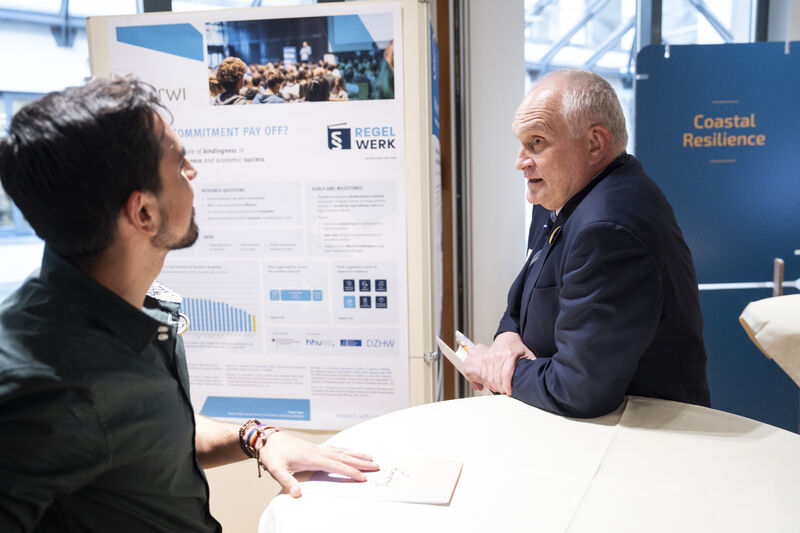
RegelWerk at the Leibniz Europe Office anniversary

1 September 2026 · Event in Brussels

RegelWerk was represented by project partner RWI at the Leibniz Europe Office’s 20th anniversary. The event brought together researchers, policymakers and civil society to discuss Europe’s future.

Read about the event (German)

Two people discussing a RegelWerk poster at the Leibniz Europe Office anniversary event.
Photo: Zacarias Garcia

RegelWerk at HERDSA 2026 in Singapore

8 July 2026 · Conference in Singapore

Shirin Reiter and Jan-Christoph Ohnesorge (DZHW) presented their research on student service and examination rules in Germany at HERDSA 2026. Their presentation explored how student autonomy and the binding nature of institutional rules relate to student success.

View the conference programme

Original title and details

Does student autonomy hinder student success? Student service and examination rules in Germany and their impact on graduation rates. Presented by Shirin Reiter and Jan-Christoph Ohnesorge, German Centre for Higher Education Research and Science Studies (DZHW). 8 July 2026, 16:30–16:55 local time, National University of Singapore. Read the abstract (PDF).

HERDSA 2026 conference banner featuring the Singapore skyline.
Conference banner: HERDSA 2026

Comparing examination regulations across universities

3 December 2025 · Publication

Douglas Blank and Stefan Conrad introduce a prototype for comparing the meaning of paragraphs in examination regulations across universities.

Read the publication (PDF)

Original title and details

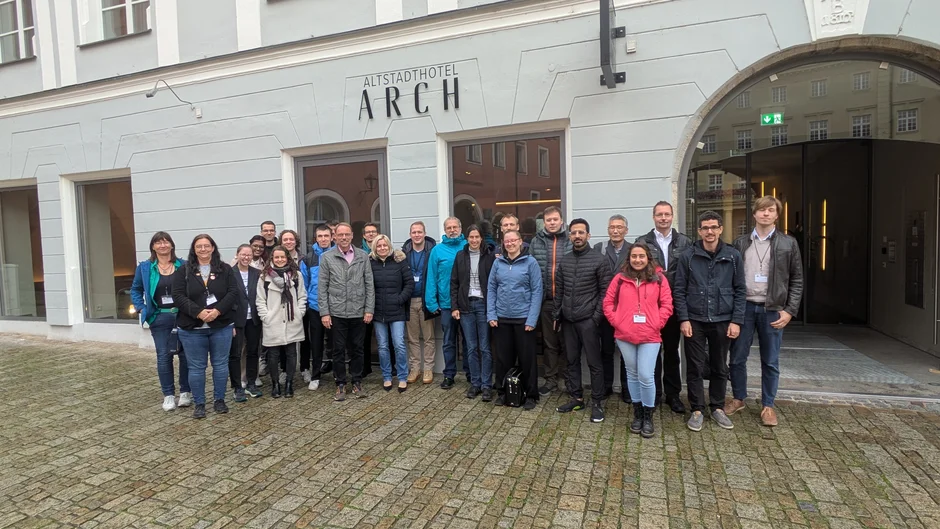
Towards Semantic Comparison of Examination Regulations: A Prototype for Cross-Institutional Paragraph Analysis. Douglas Blank & Stefan Conrad (2025). Proceedings of the 36th GI-Workshop Grundlagen von Datenbanken (29 September–1 October 2025, Regensburg, Germany), pp. 73–78. CEUR Workshop Proceedings, Vol. 4118. View the proceedings.

Workshop participants outside the Altstadthotel Arch in Regensburg.
Foundations of Databases workshop 2025

Team and partners

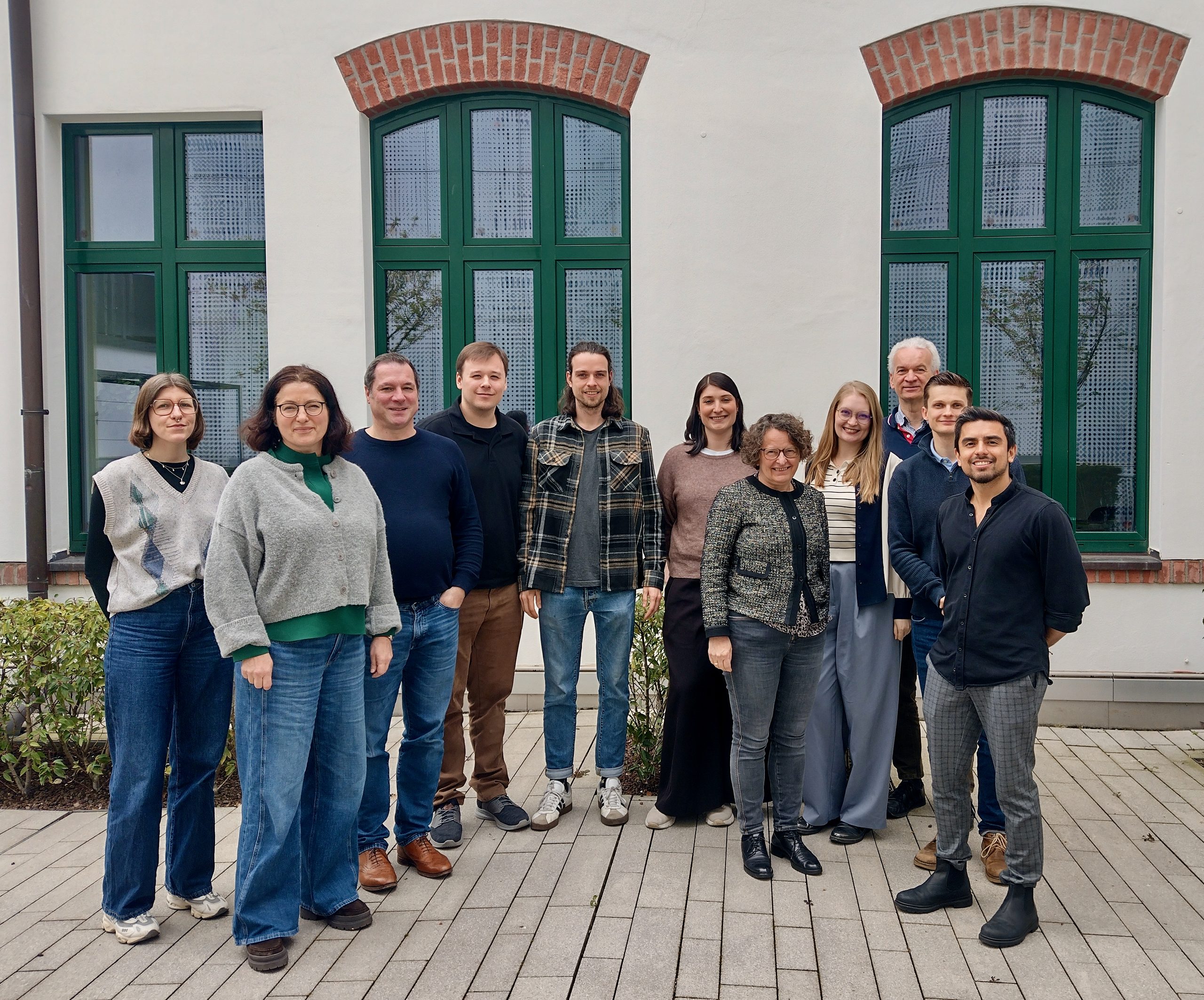
Group photo of the RegelWerk research group outside a building.

The research group

RegelWerk brings together economics, sociology, political science and computer science. Researchers at RWI, Leibniz University Hannover, DZHW and Heinrich Heine University Düsseldorf jointly investigate how institutional rules relate to students’ progress and success.

Project partners

RWI – Leibniz Institute for Economic Research
HHU – Heinrich Heine University Düsseldorf
LUH – Leibniz University Hannover
DZHW – German Centre for Higher Education Research and Science Studies

Funding

Funded by Germany’s Federal Ministry of Research, Technology and Space (BMFTR). Project period: 2025–2029.

More on the team

How can we better understand students’ progress? These selected studies connect with RegelWerk’s research questions. They come from related research projects and are not direct outputs of RegelWerk.

Institutional rules

Hönnige et al. (2024)

This working paper develops an Index of Commitment for student service and examination rules and compares regulations across Germany’s 16 federal states.

Read the publication

Study activity

Berens, Henao & Schneider (2025)

Using data from a German university, this study examines how the abolition of tuition fees relates to changes in study activity and the timing of graduation.

Read the publication

Accessible information

Thome, Hertweck & Conrad (2024)

How difficult a text feels also depends on its readers. This study examines how linguistic features and individual characteristics predict perceived text complexity.

Read the publication (PDF)

More on related research

Contact

Have a question about RegelWerk or an interest in research collaboration? We would be happy to hear from you.

regelwerk@rwi-essen.de

Diese Seite verwendet Cookies, um die Nutzerfreundlichkeit zu verbessern. Mit der weiteren Verwendung stimmst du dem zu.